History of Printing. Offset Printing
The birth of the premier technology for mass printing. (1875)


By the end of the 19th century, direct printing technology had hit a wall. While it worked smoothly for absorbent materials, printing on metal remained an unsolved puzzle. The breakthrough came from a Briton, Richard Barclay, who had the idea of adding an intermediate roller to a rotary machine. The image was first transferred to flexible rubber and then to rigid tin. The method was dubbed “offset”, having been successfully tested on tea tins in 1875.
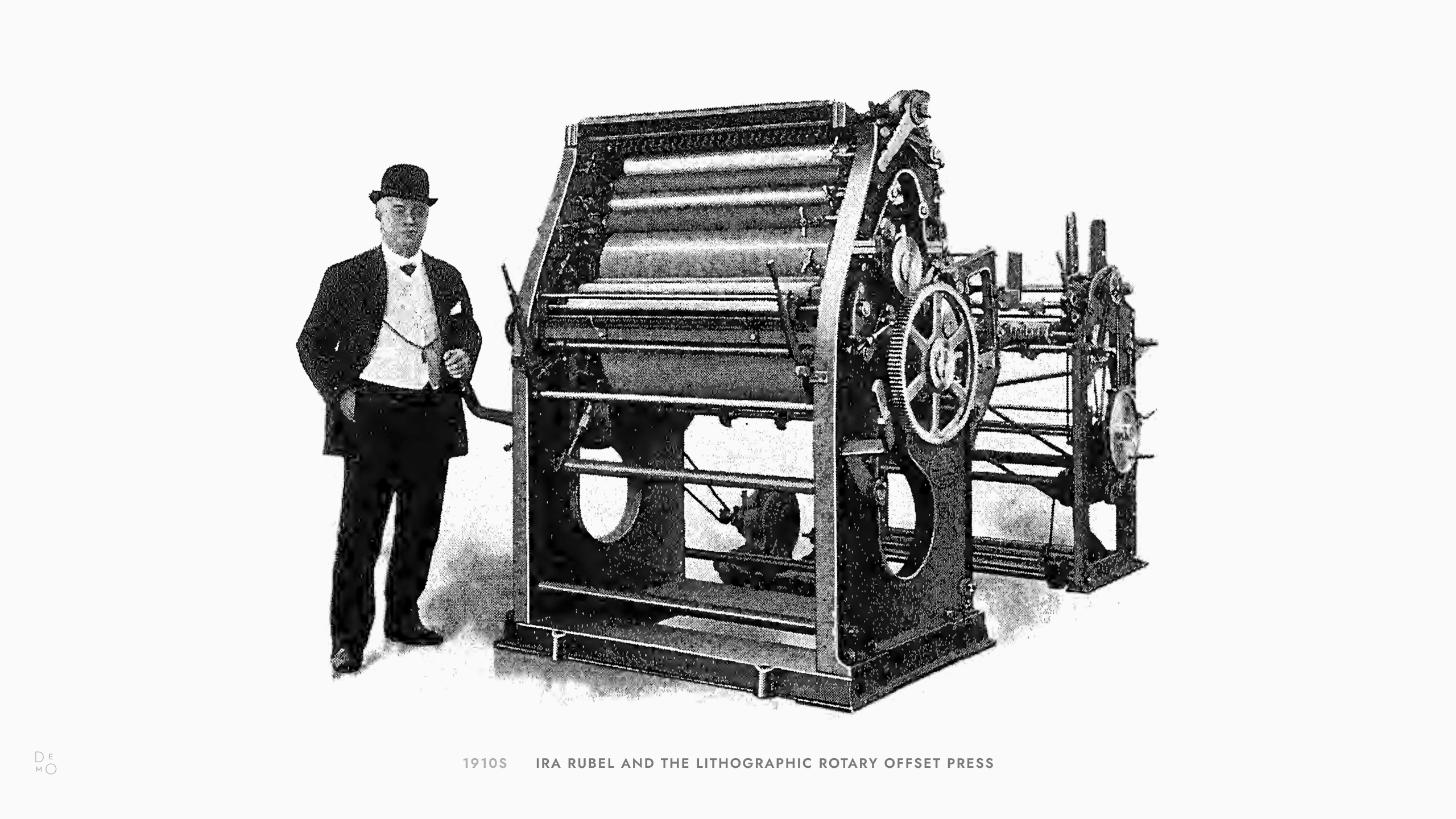
However, the real revolution in book printing happened by mistake. In 1904, an American named Ira Rubel noticed that when a sheet accidentally failed to feed into his press, the ink from the plate transferred to the rubber blanket of the cylinder. The next sheet of paper received an impression from both sides, and the one that came from the soft rubber was far sharper and higher in quality than the direct one. This accident became the industry standard: it became clear that indirect image transfer was the key to perfect quality on any surface.
It all came down to the properties of rubber. Acting as an elastic shock absorber, it perfectly picks up ink from the plate and releases it just as easily, filling the pores of even the roughest textured paper. In direct printing, the paper acts as an abrasive, quickly wearing down the printing plate. In offset, however, the plate only makes contact with the soft blanket, allowing for print runs in the millions without a loss in quality. As the direct successor to lithography and its chemical principles, offset printing became the foundation of modern mass culture, enabling the creation of the affordable, high-quality glossies, books, and packaging we use every day.